The General at Königgrätz
There's an interesting account of the death of Friedrich Wilhelm Freiherr Hiller von Gärtringen in Theodor Fontane's Der deutsche Krieg von 1866: Der Feldzug in Böhmen und Mähren, I've added a translation below for the English-speaking audience.
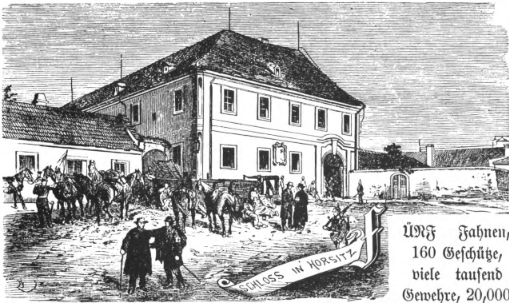
Particular sorrow was caused by the death of General von Hiller, who, bringing about the decision at Chlum-Rosberitz (as once his father had done at Belle Alliance), fell at the very moment of victory. We give here a brief account of his life:
Wilhelm, Baron Hiller von Gärtringen, descended from an old Imperial knightly family originally settled in the Grisons until the fourteenth century, was born on 28 August 1809 in Pasewalk, Pomerania. In 1826 he entered the 1st Guards Regiment as a volunteer.1 From 1834 to 1837 he attended the War School, received leave in 1842, took part in the campaigns in the Caucasus until 1844, then returned, advancing step by step through the ranks. He became a colonel in 1856 and a brigadier in 1859.
In January 1866 he received command of the 1st Guards Division — the very same division in which he had previously served as brigade and regimental commander, and in which he had begun his military career. At the head of this division he entered Bohemia, won the victorious engagement at Burkersdorf, took Königinhof, and on 3 July advanced against Chlum, instinctively recognising where the decision would be made. Chlum, and shortly afterwards Rosberitz, were captured. We have already described these battles in detail.
“During this battle and the events which followed,” writes the hand of a surviving comrade-in-arms, “General von Hiller remained upon the height at the south-western exit of Chlum, at the position which afforded the broadest and clearest overview and which, though highly exposed, was nevertheless the proper place for the divisional commander.
His troops, drawn widely apart both in depth and breadth by the nature of the terrain and by his irresistibly rapid advance, fought all around him at every point we have named. His adjutants were almost constantly on the move in order to maintain communication within the division; one of them, the young, spirited, and promising The-Losen2, met his death at the northern exit of Chlum.
The General, at the southern end of the village, was often almost entirely alone; only a few companies of the 1st Guards Regiment on foot remained near him amidst a shellfire of unprecedented violence. Calmly remaining in the saddle, the Lieutenant-General endured this for more than an hour and a quarter.
Those must indeed have been quarter-hours of the deepest inner tension! True, repeated attacks by masses of Austrian infantry against the slope were repulsed, but the isolated position of the division, following its bold advance onto the fateful height of Chlum, became more critical with every passing minute. Rosberitz was lost.
Then, at the right moment as we know, four batteries of the Guards Reserve Artillery appeared and opened a well-aimed and devastating fire upon the columns of the Austrian reserves.
With what feelings must the General have surveyed the battlefield! How it must have reminded him of his father’s great day of honour at Belle Alliance! For like his father, he too had plucked the bloody laurels through heroically daring action and storming attack. That victory would come he could scarcely still have doubted. The enemy masses had already begun to fall back, and only one concern could still occupy him: whether the other corps of the Second Army would arrive at Chlum early enough to throw their full weight into the balance of the immense flank attack.
We now know how, at ever shorter intervals, division after division hurried toward the decisive point; but we also know that, at the very moment of the glorious fulfilment of a singularly significant task — one which seemed to have passed from father to son as an inheritance — a shell struck him dead from the saddle.”
Wilhelm von Hiller was an imposing, upright, disciplined soldierly figure, dark of eye and hair, serious and measured in bearing and movement. To those whom he knew and trusted he showed himself open and talkative; towards strangers, or towards unwelcome personalities, he understood how to display a particularly cool and aristocratically reserved manner, which perhaps often repelled more sharply than he intended. The truly knightly foundations of his thoroughly noble character revealed themselves throughout his entire nature and won him the affection and esteem of all the best men around him.
The mourning for him was profound. In his letter to the Queen, the King named him first among all the fallen:
“You will already know that General Hiller of the Guards has fallen; a great loss.”
Songs were sung about him, the “Son of the Lion of Plancenoit”:
A man of war was he, bright as steel,
And victory he knew how to compel;
The King’s Guard he led into battle —
Lord Hiller von Gärtringen.
The fresh laurels of Trautenau
Bound around the hero’s brow,
Death for King and Fatherland
He found at Chlum.
Thus it sounded in those days.
1. “I was fortunate,” he wrote in later years, “to become the youngest member of this distinguished troop. The regiment deserved this designation then, and has continued to deserve it without interruption, as can best be judged by the man who received his first military education within it and who later had occasion to become closely acquainted with many other military conditions and circumstances.
The spirit of old Prussian service — the principles and concepts founded by Friedrich Wilhelm I, which formed the basis of the Prussian officer corps — had been preserved most vividly from generation to generation in the old nursery-school of the Prussian Army in Potsdam.”
2. Fontane's source names one of Hiller’s adjutants as “The-Losen”, almost certainly an abbreviated or typographically compressed form of a junior officer’s name, though his precise identity remains uncertain. - My note.