Ems Dispatch - Benedettistein
It's that time again, so a few more small thoughts about the famous Ems Despatch, 156 years ago on the 13th July 1870.
I've posted about the Emser Depesche a few times before, but the coming anniversary led me to have a little chat with AI in the pub about it, particularly about where the blame, if any, lies. After some discussion we came up with the conclusion below, which is about as close as I'm likely to get to an answer I think.
The French still did seem awfully touchy to me, who'd have thought. It's much more difficult to provoke someone if they're being reasonable in my experience.
By the summer of 1870, Bismarck, Roon, and Moltke appear to have concluded that a war with France had become increasingly likely and, if it was ultimately unavoidable, that it would be better fought sooner rather than later, while Prussia still enjoyed clear military and diplomatic advantages.Bismarck's publication of the Emser Depesche can therefore be seen not as the creation of a war from nothing, but as the deliberate removal of diplomatic ambiguity. He forced the French government to make a clear choice: accept another diplomatic setback or escalate the crisis. The French government, influenced by questions of prestige, domestic politics, and an overestimation of its own military strength, chose war.
This interpretation does not absolve Prussia of responsibility. Bismarck intentionally increased the likelihood of a confrontation and believed that, should war come, the circumstances favoured Prussia. Equally, it does not support the view that France was somehow tricked into war. France retained full freedom of action and made the sovereign decision to declare war.
The result, it seems to me, was a crisis in which responsibility was shared but not symmetrical: Prussia deliberately narrowed the diplomatic options, while France deliberately transformed a political crisis into a military one.
So it isn't really a story about someone forcing another state to act. It's about one sovereign government deliberately presenting another sovereign government with a decision under unfavourable conditions.
Whether that was statesmanship or manipulation is the debate, I think you can probably guess which side I'm on.
As an aside, this article: Bismarck Remembers the Evening the Ems Dispatch was Edited led me down a rabbit-hole about Prussian/German diplomatic ciphers. I may bore you with a post about it another day.
32413 74811 46083 64916 35702?
To finish, here's a translation of the poem that I found inside a volume of Treitschke's Deutsche Geschichte im neunzehnten Jahrhundert, which appears to be by an unknown, probably local, poet on the occasion of a wreath-laying or commemoration at the Benedettistein in Bad Ems. Apparently a popular annual event for a while.
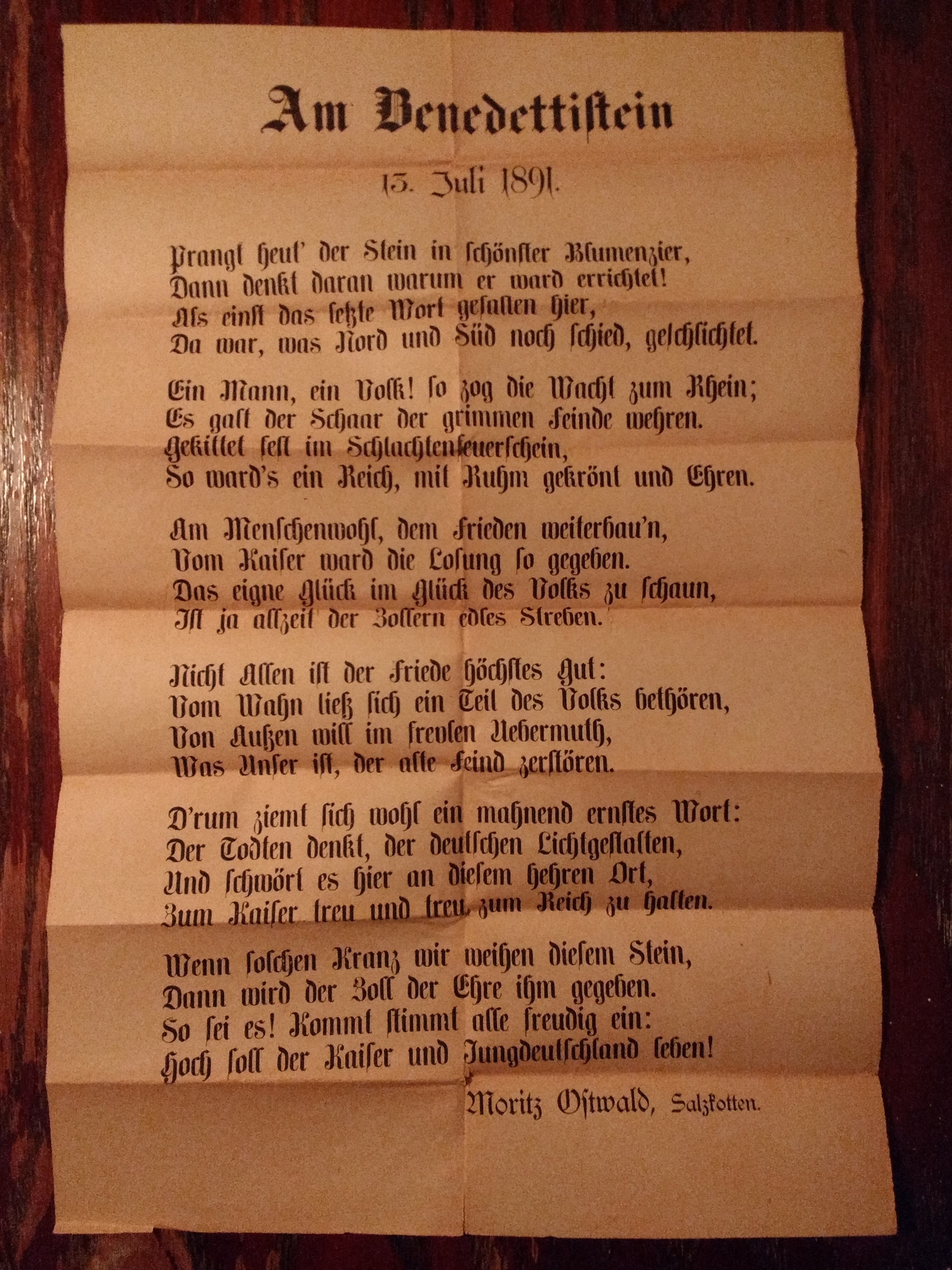
At the Benedetti Stone15 July 1891
If today the stone shines forth in fairest floral dress,
Then think upon why it was raised!
When once the final word was spoken here,
Then what still parted North and South was settled.
One man, one people! Thus the watch moved to the Rhine;
The host of grim enemies had to be resisted.
Firmly cemented in the glow of battle-fire,
Thus it became a Reich, crowned with fame and honour.
To build further upon human welfare and upon peace —
Thus was the watchword given by the Kaiser.
To see one’s own happiness in the happiness of the people
Has ever been the noble striving of the Hohenzollerns.
Not to all is peace the highest good:
A part of the people let itself be beguiled by delusion;
From without, in wanton arrogance,
The old enemy seeks to destroy what is ours.
Therefore a solemn word of warning is well fitting:
Remember the dead, those German figures of light,
And swear it here, in this exalted place,
To hold faithfully to the Kaiser, and faithfully to the Reich.
When we dedicate such a wreath to this stone,
Then the tribute of honour is paid to it.
So be it! Come, join in joyfully, all together:
Long live the Kaiser and Young Germany!
* Vielen Dank an Arne für den Kalender: Juli - Kaiser-Wilhelm Denkmal in Bad Ems.