Fehrbellin 1675 - Hakenberg Denkmal
Today is the official anniversary of the battle of Fehrbellin in 1675, not the first post I've made about it. The date became almost sacred in Prussian military memory. Fehrbellin anniversaries were celebrated into the Imperial era, and monuments such as the Hakenberg victory column were erected to commemorate the battle.
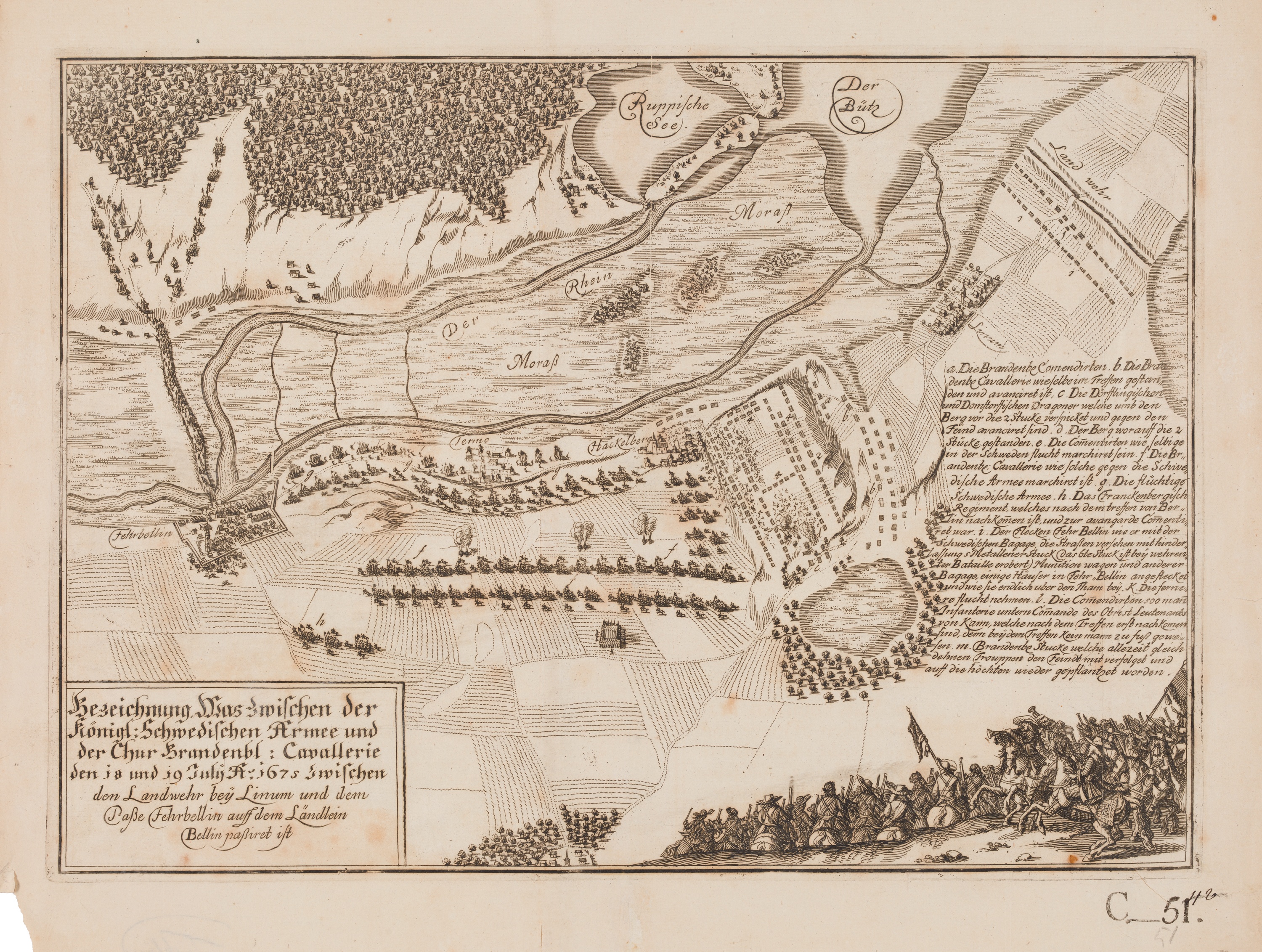
A summary of the battle below, followed by a translation of the German Wikipedia page for the Hakenberg Siegessäule, as the English version is a little sparse.
The Battle of Fehrbellin was fought on 18 June 1675 according to the Julian calendar then used in Brandenburg, equivalent to 28 June in the Gregorian calendar. It took place near Fehrbellin, north-west of Berlin, during the wider Dutch War and the related conflict between Brandenburg-Prussia and Sweden.
Swedish forces had entered Brandenburg from their north German possessions while the main Brandenburg army was away campaigning with the Emperor against France. Elector Frederick William of Brandenburg, later known as the Great Elector, brought his army back towards the Mark in forced marches. In the days before the battle, Brandenburg troops struck Swedish positions at Rathenow and Nauen, forcing the Swedish army to withdraw towards Fehrbellin and the crossing over the Rhin river.
At Fehrbellin, the Brandenburg force was commanded under the Elector by Field Marshal Georg von Derfflinger, with Prince Friedrich of Hesse-Homburg also playing a prominent role. The Brandenburgers had a force made up largely of cavalry, supported by a small number of guns. The Swedish army, under Waldemar von Wrangel, had more infantry and artillery, but was caught during its retreat through difficult marshy country.
The key ground was the sandy height near Hakenberg. Brandenburg artillery was brought onto this position and opened fire on the Swedish right wing. Swedish troops attempted to take the guns, and the fighting centred on possession of this height and the roads leading towards Fehrbellin. After several hours of fighting, the Swedes withdrew. The Brandenburgers held the field, but the Swedish army was not destroyed.
Militarily, Fehrbellin was a limited action rather than a vast battle on the scale of the Thirty Years’ War. Its immediate result was that the Swedish threat to Brandenburg was removed and the Swedish army retreated from the Mark. Its later importance was much greater than its size. In Prussian memory, Fehrbellin came to stand as the first great victory of the Brandenburg-Prussian army and as an early milestone in the rise of the Hohenzollern state.

The Hakenberg Victory Column is a 36-metre-high monument in Hakenberg near Fehrbellin. It commemorates the victory of the Brandenburg Elector Frederick William over the Swedes at the Battle of Fehrbellin on 18 June 1675, a victory that earned him the epithet “the Great Elector”. It stands on the hill where the Brandenburg artillery position was located during the battle.
The Victory Column originated from an initiative of the Prussian Crown Prince Frederick William, later Emperor Frederick III, who also laid the foundation stone on 18 June 1875. The design was provided by the government councillor Paul Emanuel Spieker, while construction was supervised by the district master builder Heinrich von Lancizolle. The base storey is made of grey sandstone; the tower, built of field-fired bricks from brickworks in Hennigsdorf and Ketzin, is faced with yellow Silesian facing bricks. The construction costs amounted to 100,000 marks. A dedicated access road was built for the Victory Column and, in 1878, was planted with 140 maple and lime trees. The inauguration took place on the tenth Sedan Day, 2 September 1879. The structure became a favoured place for the annual commemoration of the Day of Fehrbellin, which was intended to recall the first victory of the Brandenburg-Prussian army created by the Great Elector. During the National Socialist period, victory celebrations were prohibited from 1936 onwards. After the Second World War, the mayor of Hakenberg wanted to have the monument demolished in 1945, but the citizens of Hakenberg opposed the plans and, with the help of the Soviet commandant, were able to prevent its demolition; only the maple avenue was felled for firewood. During the GDR period the structure fell into decay. It was not restored until the year 2000, on the occasion of the 325th anniversary, at a cost of 500,000 marks.
The two-part base has the form of a cube with four truncated edges. Resting on it is a round-tower-like superstructure which, at a height of 23 metres, carries a surrounding gallery with an observation platform. The gallery is reached by 114 steps and consists of an iron lattice structure. In its centre, on a grey sandstone cone, rises the 4.15-metre-high, 15.5-tonne gilded bronze statue of Victoria, goddess of victory. It is a recasting of the Victoria created by Christian Daniel Rauch in 1843 for Berlin’s Belle-Alliance-Platz, and was cast at the Lauchhammer art and bell foundry.
Set into the base storey is a tablet bearing the dedicatory inscription, and above it a blind niche containing a colossal bust of Frederick William. The inscription tablet and the blind niche were made from reddish-brown Swedish granite; the bust of the Elector was made in Carrara marble in the sculptor Albert Wolff’s workshop, as a copy of a work by Andreas Schlüter.